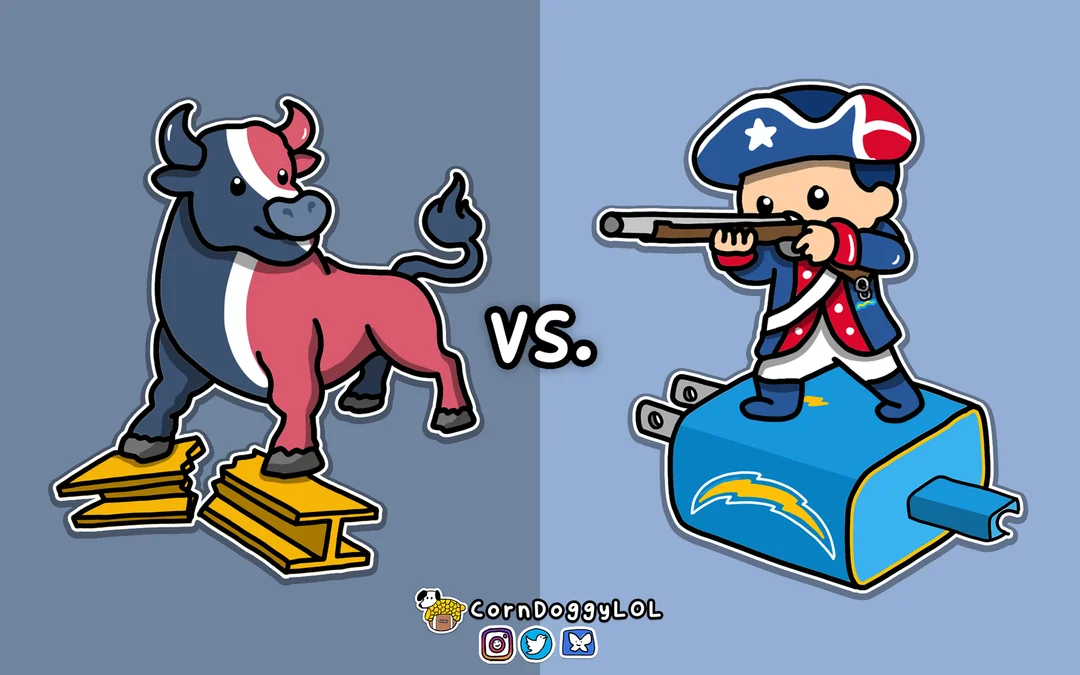
Author’s Note: Certain images are pulled from CornDoggyLoL’s posts in Texan’s subreddit. Love her art, support her here
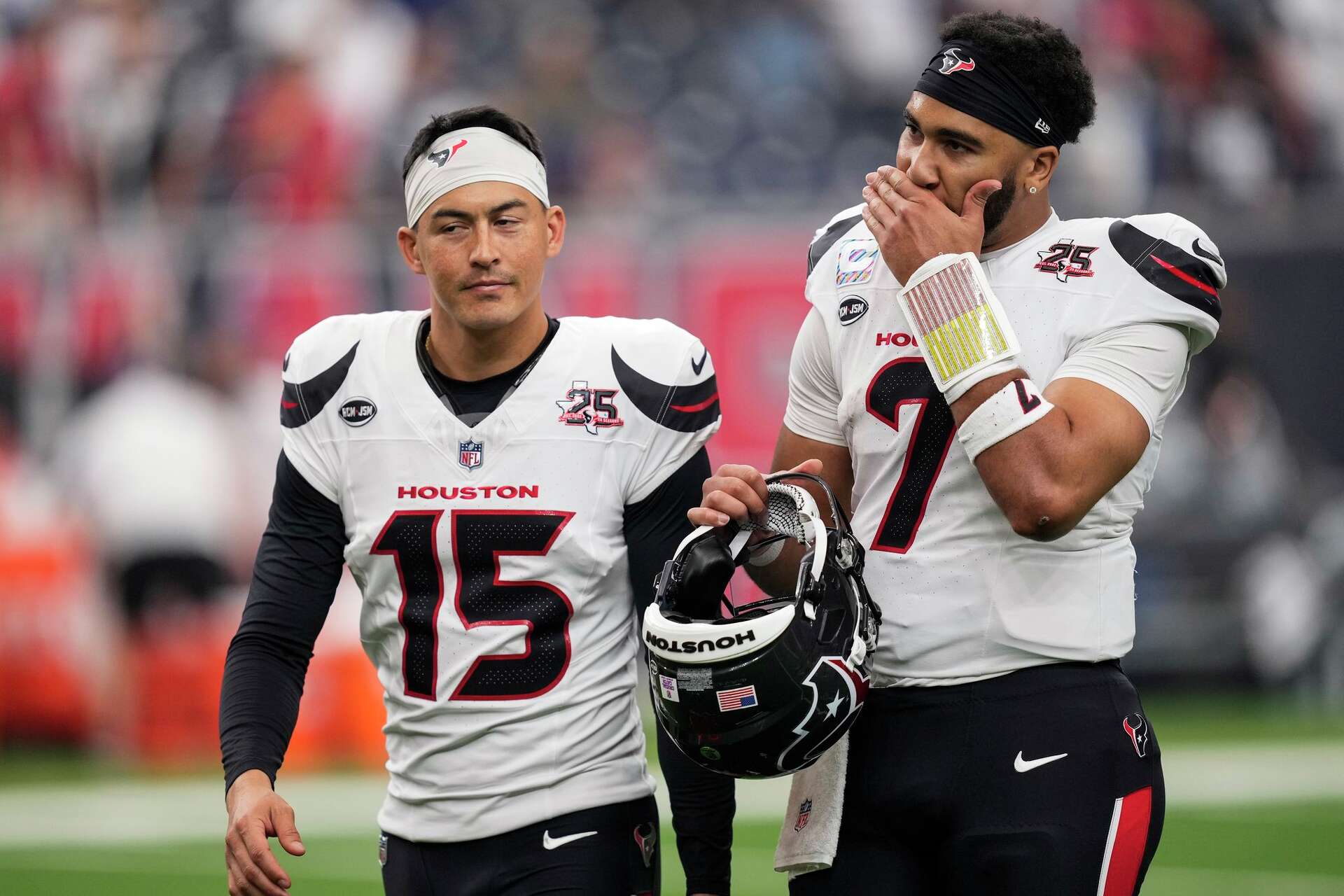
Who are the Texans? Are they the team that started 0-3, or the team riding a four-game winning streak? They’re 7-5 with five weeks left and one game out of the playoffs. Three of their remaining opponents are direct competitors for those spots. Which version shows up might determine whether Houston’s season ends in February, or December. The Texans themselves might not even know the answer.
Not Scoring Isn’t an Option
Let’s get one thing out of the way. The defense hasn’t changed. If anything, the Texans defense has only gotten better since Week 1, where they held the high-powered Rams to just 14 points, their lowest output of the season. Over the four-game win streak, the Texans defense has had 17 sacks and given up an average of 19.25 points per game. With Will Anderson Jr. and Danielle Hunter terrorizing QBs up front, and Derrick Stingley, Kamari Lassiter, and Caden Bullock setting up a no-fly zone in the secondary, it’s usually a bad day for the opposing QB and co.
So, what exactly has changed?
The offense. Start with protection: during the 0-3 start, the Texans allowed 8 sacks in three games (2.67 per game). Over the four-game winning streak? Two sacks per game, including a zero-sack performance against Buffalo in Week 12. The offensive line pressure rate dropped to around 23% during the streak. A couple percentage points of pressure relief changes everything in the NFL.
Improvement’s not just left to the protection, it’s showed in the run game too. Houston averaged 95 rushing yards during the 0-3 start, never cracking 100 yards in a single game. During the win streak? 105 yards per game with three 100+ yard performances. The catalyst? Rookie Woody Marks finally getting real touches. After 3, 3, and 6 carries in the first three games (for a combined 44 yards), Caley unleashed him during the streak: 14, 18, 16, and 19 carries per game, averaging 61 yards and chipping in a touchdown. Marks ranks 25th in the NFL in explosive runs despite starting just four games. His speed contrasts with Nick Chubb’s power enough to keep defenses guessing. The offensive line isn’t dominating anyone, but they’re creating just enough room for a two-headed attack that stays functional.
Caley also leaned into another rookie during the streak. Jayden Higgins went from an afterthought (4 catches on 5 targets for 65 yards total in the first three games) to a legitimate weapon. Over the four-game stretch, he’s caught 18 passes on 28 targets for 200 yards and two touchdowns. His yards per route run jumped from 1.6 overall to 3.2 during the streak. His dominator rating climbed from 18% to 35%. What that means in practice: defenses can’t just bracket Nico Collins anymore. Higgins’ 28.89 weighted opportunity rating isn’t elite, but it’s high enough that when Collins draws double coverage, there’s a real threat on the other side.
With better protection, a functional run game, and emerging playmakers came better production overall. 12.7 points per game during the 0-3 start. 23.75 over the last four games. New OC Nick Caley figured out how to maximize what he had, and part of that meant diversifying the offense. Whether it was Davis Mills filling in for an injured CJ Stroud or Stroud himself returning in Week 13 against Indianapolis, the formula stayed consistent: protect the quarterback, alternate between Marks and Chubb, let Higgins keep defenses honest when they focus on Collins, finish drives.
The numbers tell the story. When kept clean from pressure, Stroud posts a 107.7 passer rating. Mills? 91.7. Both are effective with time, but Stroud is elite. That’s why opposing defenses blitz him 7% less than they blitz Mills. They respect what he can do when given space and options.
The O-line isn’t suddenly elite. A 23% pressure rate and 105 rushing yards per game are solid, not spectacular. Marks isn’t breaking the league. Higgins isn’t a number one receiver. But the offense finally has enough threats that defenses can’t key in on just Collins and Chubb. When you pair functional offensive line play, multiple viable options, the league’s best defense, and a quarterback who thrives in clean pockets, you get four straight wins and a 7-5 record with the playoffs in sight.
Playoff Knife Fight
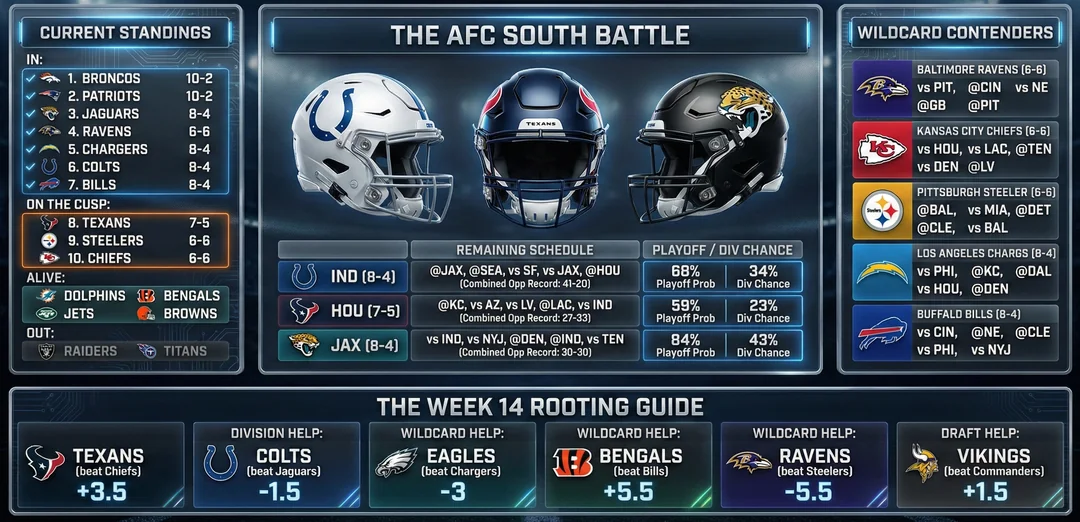
Chiefs, Cardinals, Raiders, Chargers, and Colts. All that remains between the Texans and the playoffs. With the Chiefs at 6-6, Chargers at 8-4, and Colts at 8-4, the Texans are competing with their direct rivals for the final playoff spots. The Cardinals (3-9) and Raiders (2-10) look like easy wins on paper. But spoilers don’t care about records, and trap games end seasons. The premise is simple: win and they’re in. Let’s dive into the matchups.
Chiefs

The more things change, the more things stay the same. Patrick Mahomes is looking as good as ever with Rashee Rice back from suspension (81 receiving yards per game since Week 7). Travis Kelce is rejuvenated playing as a secondary option, posting 719 receiving yards, second among tight ends. Their defense gives up 1.17 EPA/play (bottom 10 in the league), but they lock down in the red zone, allowing just 19.3 points per game.
Why then are they behind the Texans in the standings? The Chiefs aren’t clutch this year, shocking as that is. They’re 1-6 in one-score games. Last season they were 11-0. The margins have flipped.
That doesn’t mean it’ll be easy for the Texans going to Kansas City. The Chiefs historically have owned this matchup, and they’re fighting for their playoff lives. But Houston matches up well on paper. Kansas City’s offensive line is banged up, and a hungry Will Anderson Jr. and Danielle Hunter should have Mahomes running for his life. Rashee Rice is one of the best receivers against zone coverage, but he’s about to face Derrick Stingley, THE best cover cornerback in the NFL right now. Stingley has given up single-digit receiving yards in each of the past four games and allows just 0.7 yards per route run against zone. Kamari Lassiter on the other side isn’t far behind at 1.0 YPPR. Anywhere Mahomes looks to throw, he’ll be looking twice.
The question then becomes the offense. Can CJ Stroud use the time the improved O-line gives him to pick apart the Chiefs? Steve Spagnuolo, the Chiefs DC, specializes in disguising coverages and blitzes, so it’ll be up to OC Nick Caley and Stroud to use the improved run game and wide receiver group to keep the defense guessing. If the offensive line holds up and Stroud makes quick decisions, Houston has a shot. If Mahomes gets hot and the Texans fall behind early, it’s over. This one comes down to the fourth quarter, and in tight games this year, Kansas City hasn’t been clutch. The Texans steal this one on the road and exorcise the playoff demons. Final Score: Texans 27, Chiefs 24.
Cardinals
The Cardinals are currently 3-9 and are already eliminated from the playoffs. Classic Cardinals. Like the Chiefs, that record comes down to futility in one-score games (0-9), they just can’t close. With Kyler Murray out with a Lisfranc injury, backup Jacoby Brissett has kept the offense functional by feeding the beast (beast being Marvin Harrison Jr., Michael Wilson, and Trey McBride). That pass-heavy approach gives them a puncher’s chance against better teams.
Their major downside is their one-dimensionality. No Cardinals rusher has broken 100 yards all season, and they’re averaging just 100.6 yards per game on the ground. That plays right into Houston’s hands. The Texans can sell out to stop the pass, let Anderson and Hunter pin their ears back, and force Brissett into mistakes the secondary will capitalize on.
Offensively, Houston should control this game. Arizona’s defense is opportunistic (10th in turnovers) but gives up 219.6 passing yards and 112.6 rushing yards per game. The Texans can methodically move the ball, avoid mistakes, and let the defense do the heavy lifting. Houston wins this one comfortably. Final Score: Texans 20, Cardinals 14.
Raiders
The Raiders entered the season with optimism: new head coach Pete Carroll, Geno Smith at quarterback, and Ashton Jeanty as their star rookie running back. They didn’t anticipate sitting at 2-10, kicking the tires on another wasted season.
There aren’t many positives about the Raiders. Offensively, they’re a travesty, averaging 4.1 air yards per completion and 3.4 yards per rush. Geno Smith leads the league in interceptions (14). Jeanty is averaging just 3.5 yards per carry, but 1.2 of those come before contact, showing he’s doing what he can behind a terrible offensive line. Brock Bowers is transcendent, but he gets double-covered every game as the only meaningful target. Defensively, they’re no better, giving up 25.6 points per game with a 67.2% completion percentage allowed and ranking bottom 10 in sack rate.
This makes the path to winning straightforward. Blitz Geno Smith, double-cover Brock Bowers, crash the line whenever Jeanty runs. I expect the Texans defense to eat the Raiders’ lunch. Offensively, I expect short fields and ball control. As long as the offense doesn’t turn the ball over, Houston wins easily. Final Score: Texans 23, Raiders 7.
Chargers
The Chargers sit at 8-4, fifth in the AFC. Impressive, considering the injuries wracking their offensive line (Joe Alt and Rashawn Slater out for the year) and running back rotation (top two backs Najee Harris and Omarian Hampton both gone).
Herbert still has weapons though. Ladd McConkey leads the receiving corps, Quentin Johnson is having a career resurgence, and Oronde Gadsden has emerged at tight end. Keenan Allen serves as the veteran safety valve, and Kimani Vidal has stepped up from third-string running back to starter. All four pass catchers have between 500-600 receiving yards. Everyone eats.
That makes them the toughest opponent on the remaining slate. Not an impossible one, though. Those offensive line injuries have significantly weakened the Chargers. Their makeshift line gives up a 40.2% pressure rate, and Herbert gets sacked 8.8% of the time. I can already see Danielle Hunter and Will Anderson Jr licking their chops.
The few times protection holds up? Houston’s zone-heavy defense (77.8% zone vs. 17.4% man) will be tested by the Chargers’ balanced receiving threats. It comes down to whether Stingley, Lassiter, and the safeties can hold coverage long enough for the pass rush to get home.
On the flip side, the Chargers defense isn’t a slouch either. They’re seventh in the league in EPA/play with a stout defense that limits explosive plays (7.68 ADOT allowed yards per completion, 4.5 yards per carry). Stroud will need quick-developing passes, and the Texans will lean heavily on Woody Marks and Nick Chubb to sustain drives and keep LA’s offense off the field.
This will be a dogfight. The Chargers are fighting for playoff positioning too, and at home, they get it done. Not pretty, not explosive, just enough. Final Score: Chargers 20, Texans 16.
Colts

The Colts’ loss to the Texans in Week 13 knocked them out of the division lead. Will this Week 18 matchup be the moment that knocks them out of the playoffs?
Until Week 8, Indianapolis looked like the class of the AFC, racing to a 7-1 record. Daniel Jones earned the nickname ‘Indiana Jones’ with his career resurgence under Shane Steichen (257.5 passing yards per game during the streak). Jonathan Taylor ran rampant (106.25 rushing yards per game) and inserted himself into MVP discussions. Since then? They’ve gone 1-3, all tight losses, but losses nonetheless.
That 1-3 stretch doesn’t tell the whole story. The Colts still lead the league in EPA/play (.14) and can beat you two different ways. Spread them out with receivers? 54.11 total EPA in 11 personnel. Go heavy with tight ends? 52.31 EPA in 12 personnel. Steichen’s scheme is versatile and explosive, using weapons like Michael Pittman, Alec Pierce, and Tyler Warren to stretch the field while Taylor hammers defenses into dust.
They’re hungry. The Texans are too. Division games mean more, especially with playoffs on the line. Daniel Jones is nursing a fractured fibula, which saps his elusiveness in the pocket. The Texans saw it in Week 13, pressuring Jones on 41.7% of his dropbacks. He completed just 2 of 11 passes against the blitz. Expect more of the same in Week 18.
Offensively, the Texans need to attack a weakened Colts secondary. Their best CB, Sauce Gardner, is week-to-week. Nico Collins and Jayden Higgins need to take advantage. If Indianapolis sells out to stop the pass, the Texans should counter with wheel routes and dumpoffs to the backs, exploiting space underneath given how the Colts shut down Houston’s run game in Week 13 (3.2 yards per rush allowed).
The injuries and schematic pressure will be too much for the Colts to overcome. Houston gets revenge and keeps their playoff hopes alive. Final Score: Texans 23, Colts 19.
Playoff Team or Paper Tiger?
The Texans have clawed back from 0-3 to 7-5. Every aspect of the team screams contender. Elite defense? Check. Emerging weapons? Check. An O-line that finally protects Stroud? It’s all there. Now it’s time to show it. Take one from the Chargers or Chiefs, and the Texans are the team no one wants in the playoffs. Lose to the Cardinals or Raiders, and it’s another fool’s gold season. Five games to lay it on the line. The NFL is waiting.