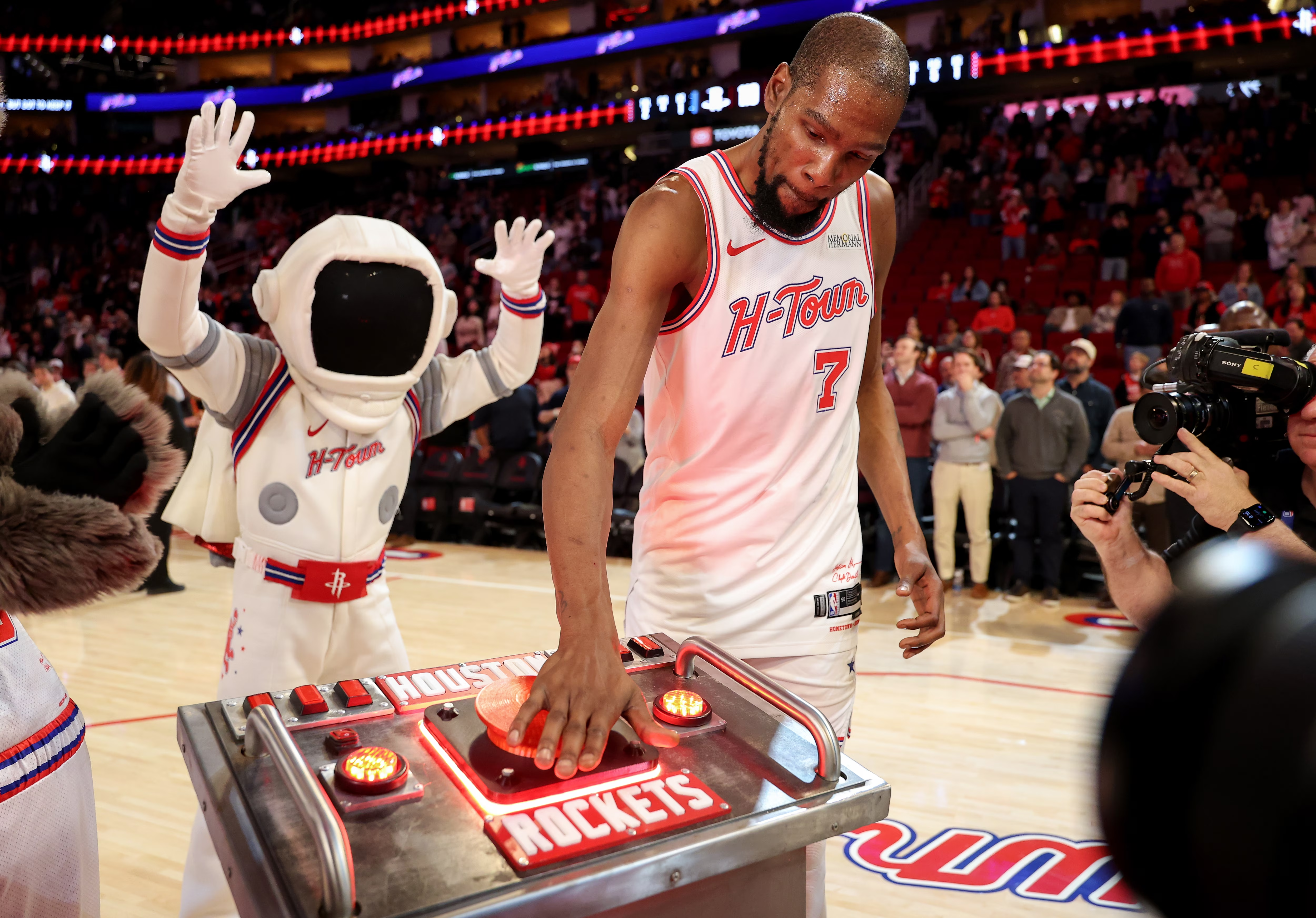
Gamecube, Nintendo. A celebration born from tough times that’s now become the soundtrack to Rockets dominance, with them sitting at 15-6 and fourth in the Western Conference (1 games back of 2nd, 6.5 games back of 1st). They’re better than the record indicates, with a net rating of 8.8 (2nd) and point differential of 10.6 (2nd).
How are they doing this? Two-fold. Defensive dynamo Amen Thompson leads a swarming defense ranked 2nd in ppg and defensive rating. On the other end, Alperen Şengün and Kevin Durant lead a dangerous Houston offense stocked with shooters, ranked 2nd in offensive rating and 4th in ppg.
With these three being able to take over the game in different ways, let’s dig deep to find the player making the whole thing work.
Mid-Range Mercenary
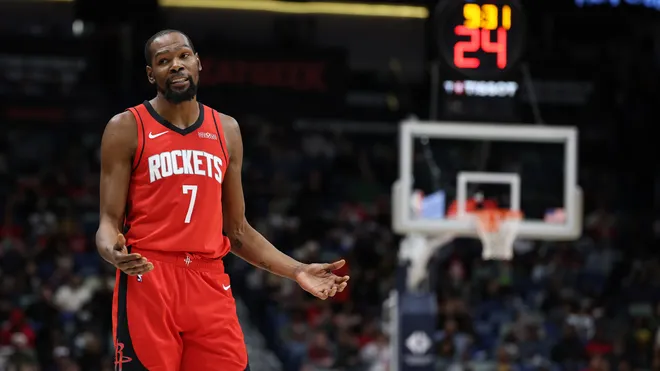
Kevin Durant. A 7-foot man who can get a shot from anywhere on the floor. He can make a shot from anywhere on the floor too. The Rockets traded for KD from the Phoenix Suns before the start of the 2025-2026 season to juice their offense, and the results have predictably been phenomenal.
They’ve jumped from a 115.37 offensive rating (13th in the league) to 123.95 (2nd), an 8.5-point leap. The defensive rating slipped slightly from 4th to 5th, but the improved offense is easily worth it. He’s doing all this while fitting into the Rockets’ scheme, dropping to a usage rate (25.7%) that we haven’t seen from Durant ever.
In 2024-2025, the Rockets in the clutch had a 106.6 offensive rating (bottom half of the league). In 2025-2026, that’s up to 114.4. Watch two separate isolation plays where the Rockets cleared out and let KD go 1-1 with the opposing defender. A crossover into a stepback, cooking Wendell Carter Jr. to force OT, then a fadeaway jumper over Tristan da Silva to take the lead in OT.
Last year’s Rockets were sorely lacking a clutch scorer, and with KD’s addition, they have one.
But can a 37-year-old newcomer truly be the lynchpin? That career-low usage rate cuts both ways. Yes, it shows Durant can defer, but it’s been accompanied by a REB% (6.7%), AST% (15.7%), and TS% (61.4%) that are all near career lows. Then again, maybe that suits the Rockets. Houston has Şengün to orchestrate and a system built around pounding the glass, they don’t need Durant to do everything. They just need him to score, and he’s doing that at an elite level.
Ultimately, it comes down to what the ‘lynchpin’ is: the player who does the most, or the player who does what the team needs most?
Homegrown Hub
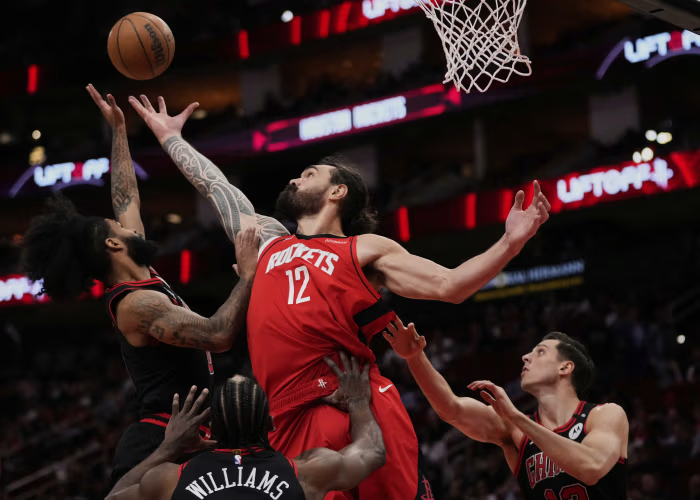
Here’s a player doing the most, Alperen Şengün. Jumping from averaging 19.1/10.3/4.9 as a first time All-Star in 2024-2025 to averaging 23.1/9.1/7.1 in 2025-2026. Top-10 in apg, top-20 in rpg, and just outside the top-20 in ppg. Doing this while having career high AST/TO ratio (2.18) and close to career highs in USG% (26.1%) shows how the game is slowing down for Şengün, allowing him to combine efficiency with gaudy box score numbers.
Şengün operates as Houston’s hub. Here he’s playing against the Cleveland Cavaliers, the league’s 4th-ranked defense at the time. On the first play, Şengün drives to the basket, draws multiple defenders with his gravity, then finds the open man. The rest of the clip is pure domination: backing down defenders, spinning for scores, or making the right read when help rotates. Houston’s offensive structure in a nutshell: Şengün as the hub making reads that unlock everyone else.
One game is one game. The on/off splits with Şengün reveal his impact. When Şengün sits, teammates get fewer easy looks, period. Assisted 2-point field goals drop across the roster because no one else can create at the same level. The offense doesn’t just slow down without him, it fundamentally changes, forcing players to create in isolation rather than flow through the system. That impact shows up clearly in the offensive rating. With Şengün on the floor, Houston posts a 124.4 (would be 1st in NBA). Without him, it drops to 116.7 (would be 10th).
Their record over the past two seasons backs that up, 66-29 with him, 1-7 without. Small sample, but the results are consistent. On paper, Şengün looks like the system.
We can’t quite anoint Şengün as the lynchpin just yet though. Even with Houston’s elite offense this year, Şengün posts a sub-60% TS% (58.2%). He shoots just 57.7% at the rim and 34.3% from midrange. Those are below-average numbers for a starting center. Last year with worse spacing, his efficiency was even lower at 54.5%. This year, Durant’s arrival changed things. Defenses can’t load up on Şengün anymore without leaving Durant open. It’s clearly benefited his efficiency, which is still below average but functional. The offense jumped from 13th last season to 2nd this season, but was that Şengün’s playmaking or Durant forcing defenses to respect the Rockets’ scoring? If Şengün needed an elite scorer to make the offense work at this level, maybe he’s not the lynchpin.
Nitpicking? Maybe. But lynchpin is a heady title. The lynchpin should be unambiguous, or barring that, should be so overwhelming in one facet that those question marks don’t matter. Şengün and KD are a chicken/egg argument. What about Amen Thompson, a player who impacts both ends, the one Houston built this defense around.
Two-Way Terror
It’s a bird, it’s a plane, it’s…Amen Thompson jumping out of the building to block Anthony Davis’ dunk.
That’s a microcosm of the defensive abilities of Amen, the most athletic man in the NBA. He can guard 1-5, go over screens, switch assignments easily, cover blown coverages, and sprint to chase down blocks. A go-go gadget man for the Rockets defense.
The eye test matches the numbers. Thompson ranks 11th in NBA in defensive rating among qualified players (107.1). Given that the Rockets post a 112.23 defensive rating overall (good for 5th in NBA), it’s clear that without Thompson, the defense would be much worse.
Lineup data backs this up. Thompson appears in four of Houston’s five best three-man combinations by net rating (minimum 200 minutes). The Rockets’ most effective units aren’t just built around him, they require him. His defensive versatility allows Houston to play multiple styles, switching everything on defense while maintaining offensive spacing. But defense is only half the battle.
He’s trying to take it to the next level. His assists have grown from 3.8 to 5.1, and his free throw shooting jumped from 68.4% to 80%, showing real skill development. But the transition isn’t smooth. He’s attempting more threes to space the floor (2.1 per game vs 1.3), but shooting just 19% on them, down from 27.5% last year. His TS% has dropped from 60.2% to 54.1% as a result. He’s averaging 17.4 points, up from 14.1 last year but the efficiency isn’t there (yet).
It’s a testament to his importance to the Rockets that they’re willing to eat his inefficiency. His defense is simply that good. Allowing him to grow into a greater offensive role is the hallmark for lynchpin development, keep ‘em doing what they’re good at and expand their responsibilities.
A lynchpin tomorrow isn’t a lynchpin today though. Thompson may be growing into a greater offensive role, but the growing pains are real, and his efficiency losses are hurting the team. The defense would be worse without him, but the starting lineup posts a higher net rating in his absence (+12.75 vs +10.88 in limited minutes), not what you’d expect from a foundational piece.
Three players, three arguments. Let’s bring it all together.
The Verdict
We’re back to where we started, trying to answer that all-important question of who’s the lynchpin? Thompson seems to be the first man out. Defense is important, but not enough to overcome that much offensive inefficiency. In a couple years though, maybe he’s made that leap the Rockets (and I) believe he can make and he’s right back in the mix for a much more difficult decision.
Two candidates now, the mercenary who can score from anywhere, and a home-grown center who runs the offense. Durant has come in and unlocked a level to the Rockets offense that hasn’t existed since the years of James Harden. That 13th to 2nd offensive rating jump is no joke. At the same time, Şengün’s impact similarly speaks for itself. The Rockets have a 66-29 record with him, and a 1-7 record without him. That’s the definition of irreplaceability. Is the ceiling raiser or the floor setter the hallmark of a team’s lynchpin?
If a lynchpin is the “most impactful player”, Durant is the obvious choice. He’s the reason the Rockets offense (and Şengün’s stats) have taken that leap to the next level. If, on the other hand, it means “most irreplaceable player”, Şengün is that guy.
Going 1-7 without him before Durant was on the Rockets, and 0-1 with Durant here shows what happens when you remove the foundation. The Rockets built an entire offensive scheme around a playmaking center who’s one of the few in the league who can execute it at this level. Durant may have unlocked the ceiling of the system yes, but without that steady foundation there wouldn’t be a ceiling to raise.
You can certainly argue otherwise. Durant is a proven closer with multiple championships who’s elevated Houston into championship contention. Last year showed the Rockets’ offense needed elite help, Durant filled that void perfectly. But the Rockets aren’t in win-now mode, they’re building the team to overtake OKC in the Western Conference. That team requires a foundation, not a finishing touch.
Because he’s the piece they can’t rebuild without. Durant makes them scary. Şengün makes them a team. That’s why Şengün is the lynchpin.