Most stats up to date to Jan 16th, 2026. Others are up to date to Jan. 12th due to delay in written article, I am in process to getting them all up to date with publication date!
1-4 in their last 5, 7-8 in their last 15. The Rockets haven’t completely collapsed. They’re still 22-14, 7th in the West, with a 6.8 net rating that ranks third in the NBA. A few weeks ago, when I wrote about Houston’s ceiling, that net rating sat above 8 and they were battling for 2nd in the conference. They’re still only two games out of that spot, but look at who they’ve been losing to. Kings twice. Trail Blazers twice. Mavericks twice. Pelicans once. Believe it or not, going backwards isn’t a good thing. These aren’t contenders exposing Houston’s flaws. They’re bottom feeders that real contenders (which the Rockets believe they are) should handle. What isn’t working with these Rockets?
Cold From Three
The modern NBA lives and dies by the 3. The Rockets are currently dying by it. Over the past five games, the Rockets are shooting a paltry 23.4% from 3, and over the past 15 games that’s still only 33.4%. Neither is close to their 37.2% season average (5th in the NBA). Before the slide, that number sat at 39.6%.
Bad news for the Rockets: it’s a team effort. Over the past five games, six rotation players are hitting under 25% from three on 1+ attempts per game (Aaron Holiday, Alperen Sengun, Amen Thompson, DFS, Jabari Smith Jr., Josh Okogie). These aren’t end-of-bench guys bricking open looks. These are real contributors cratering simultaneously. Jabari is the worst offender, launching seven threes a game and converting one of them. That’s 14.3% from deep, and it’s killing the offense.
Over the past 15 games, it’s not much better. Sengun is shooting 6.3% from three. Aaron Holiday is at 27.3%, DFS at 26.9%, Jabari at 32.4%. Their overall FG% isn’t saving them either (all three are sub-50%). When the Rockets’ shooters aren’t hitting, the offense stagnates, messes with the rotations, burns the crops, and misfiles my taxes (maybe not the last two things, but with how the season is going, you never know). The Rockets have a historically dominant offensive rebounding scheme, but no amount of offensive rebounding helps when you’re building a house out of bricks.
Look at the Trail Blazers loss on Jan 10th. The Rockets shot 23% from three and lost by six. If they’d hit league average (35.9%), that’s roughly four extra makes, twelve extra points. A six-point loss becomes a blowout win. The next day against Sacramento, same story: 23% from three, loss by 13. These aren’t close games decided by one bad bounce. They’re games the Rockets are giving away.
Houston’s Half-Court Problem
What do the Rockets do then? Run. Not in a mean way. It’s a literal description. In transition, Houston posts a 69.0 percentile ranking with 1.15 points per possession, 10th in the NBA. When they’re in motion, they’re one of the best offenses in the league.
The problem is what happens when they can’t.
Houston’s half-court offense is best called mid. Pick-and-roll ball handler actions sit at the 48th percentile. Cuts are 28th. Off-screen actions are 7th (percentile, not place. Sorry Rockets’ fans). Spot-ups, which should be a strength given their shooting talent, rank 52nd and are dragged down further when the threes aren’t falling. The only half-court action where Houston excels is isolation, where they rank in the 79th percentile. That’s most likely the effect of adding one of the greatest one-on-one scorers of all time, KD. But building a half-court offense around a 37-year-old isn’t a sustainable path to a championship (or, increasingly, even a high seed in the Western Conference).
Then there’s the putback problem. The Rockets lead the league in putback frequency at 8.4 possessions per game. Their offensive rebounding machine is working exactly as designed. The issue is what comes next. Houston ranks in the 3.4 percentile in putback efficiency, converting at just 0.97 points per possession. They’re generating second chances and doing nothing with them. All those offensive rebounds, all those extra possessions, and they’re still bricking the follow-up.
This juxtaposition is what’s holding the Rockets down. Their identity is offensive rebounding and transition scoring, but when games slow down against playoff-caliber defenses, they don’t have a reliable half-court answer. The ball stops moving, the spacing gets tight, and they’re left lobbing grenades with no time left on the shot clock. Right now, the only reliable creators are Sengun in the post or KD in isolation. One option disappears when Sengun sits. The other asks too much of an aging star. The half-court offense needs a secondary creator. The question is who.
Who is the Real PG?
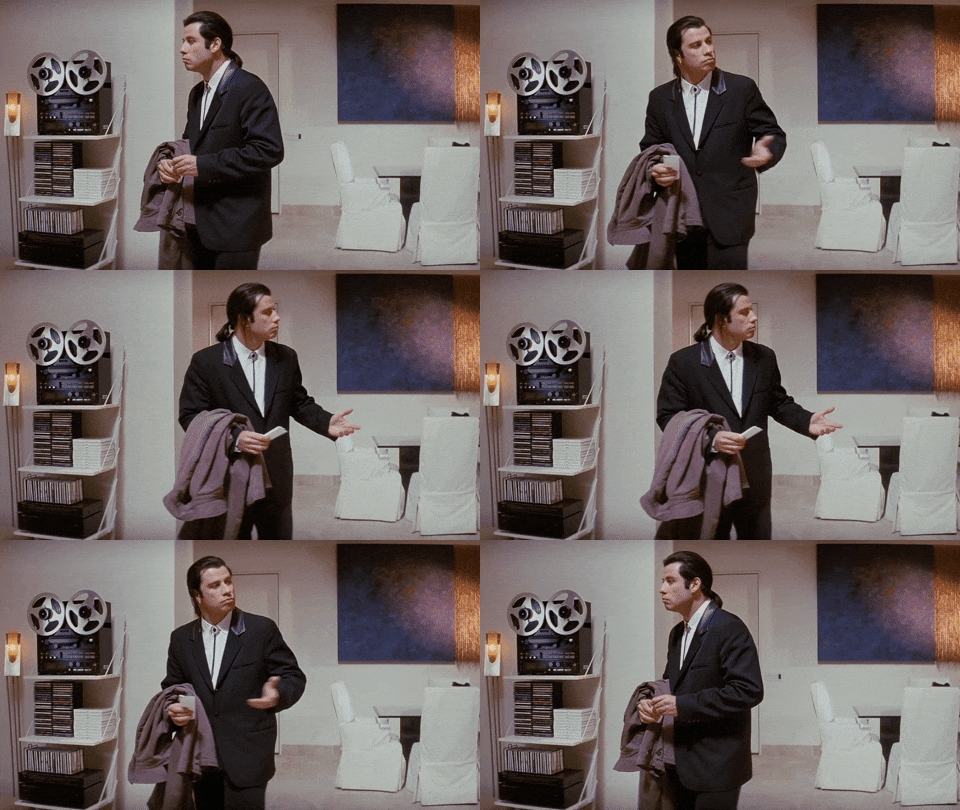
Will the real PG please stand up? The Amen Thompson experiment isn’t working. His averages look fine on paper (23/9.6/4 over the last five games, 20.7/8.2/4.8 over the last fifteen), but those are wing numbers (great wing numbers even), not point guard numbers. Four assists per game from your primary ball handler isn’t facilitating. It’s coexisting. Thompson is getting his points and crashing the glass, but the offense isn’t flowing through him the way it needs to. The other options? Reed Sheppard is a combo guard whose instincts lean toward scoring. Tari Eason is a wing. The closest thing to a true point guard on the roster is JD Davison, an end-of-bench guard averaging 2.2/0.8/1.1 in 7.5 minutes per game. I’m like John Travolta in Pulp Fiction, where is the Rockets real PG?
This wasn’t supposed to be the problem. Fred VanVleet was the team’s OG PG, but he tore his ACL during a team minicamp in September, and Houston’s been scrambling ever since. VanVleet wasn’t flashy (14.1 points, 5.6 assists last season), but he was a floor general who could run actual sets and keep the offense from devolving into everyone taking turns. The Rockets ranked 22nd in half-court efficiency last season, worst of any playoff team. That was with VanVleet. Without him? Well, you’re looking at it.
Sengun has become the default offensive hub because there’s nobody else. His assist numbers are strong (6.5 for the season, 5.9 over the last fifteen), but that’s a hub without backup. When he sits, the offense doesn’t just dip. It disappears. No secondary playmaker, no ball movement, just a bunch of isos and prayers. Defenses have figured this out. Pack the paint, take away Durant, dare Houston to beat you from three. Which, as we’ve established, they can’t do right now.
OKC has SGA . Denver has Murray (Jokic is out, otherwise you know, I’d put him). The Spurs have Castle. Houston has Amen Thompson posting a 1.76 AST/TO and Reed Sheppard coming off the bench. That’s less a gap and more a cataclysm.
I wrote about starting Reed back in December when the Rockets were 15-6 and life was good. The argument made sense then, let Amen focus on defense and slashing and Reed run the show. Win/Win. But that was before seven losses in fifteen games exposed deeper cracks. The question isn’t just about starting lineups anymore. It’s whether anyone on this roster can actually be the point guard Houston needs. Maybe they still can, but the Rockets are running out of time fast. It’s less a “oh, we can figure this out” and more, “oh, we NEED to figure this out”. Otherwise, the Rockets are going to crash and burn (or limp into the playoffs and get blown out, resulting in fans complaining and Ime getting put on the hot seat. Tale as old as time).