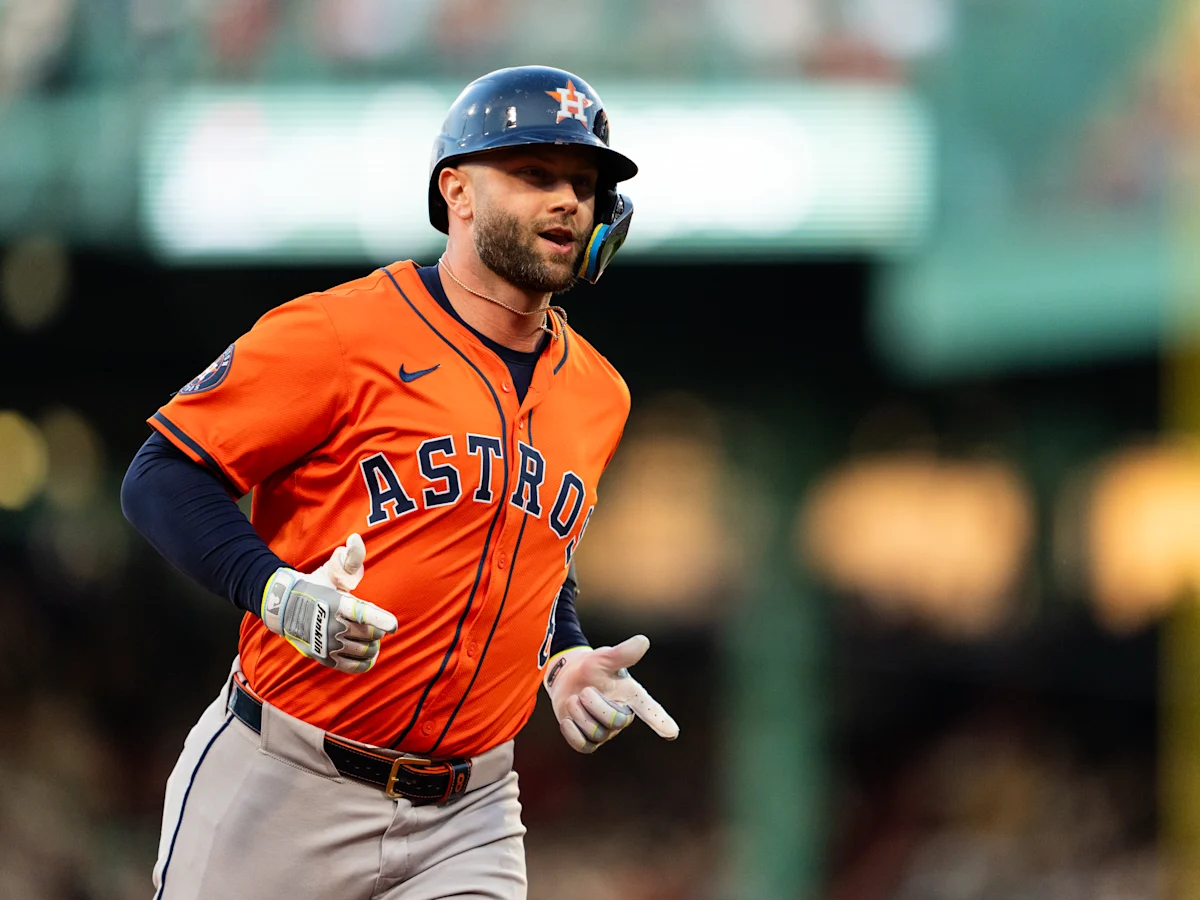
Houston (Astros), we have a problem. Too many players to play in the infield. That sounds like I’m complaining about my steak being too buttery, or my lobster being too juicy, but the farm system is barren and the best trade piece the Astros have (Paredes) doesn’t have a position at the moment (given the lack of trade value for Christian Walker encasing him at first). One trade solves both.
Paredes isn’t a 40-home-run masher. He’s a different kind of hitter: pull-optimized, fly ball heavy, built to punish short porches. His career 51.7% pull rate is 14 points above league average. His pull-side air ball rate (32.2%) is nearly double the MLB norm (16.7%). In 2025, both numbers spiked even further (56.9% pull rate, 38.5% pull AIR%). The spray charts tell the story.
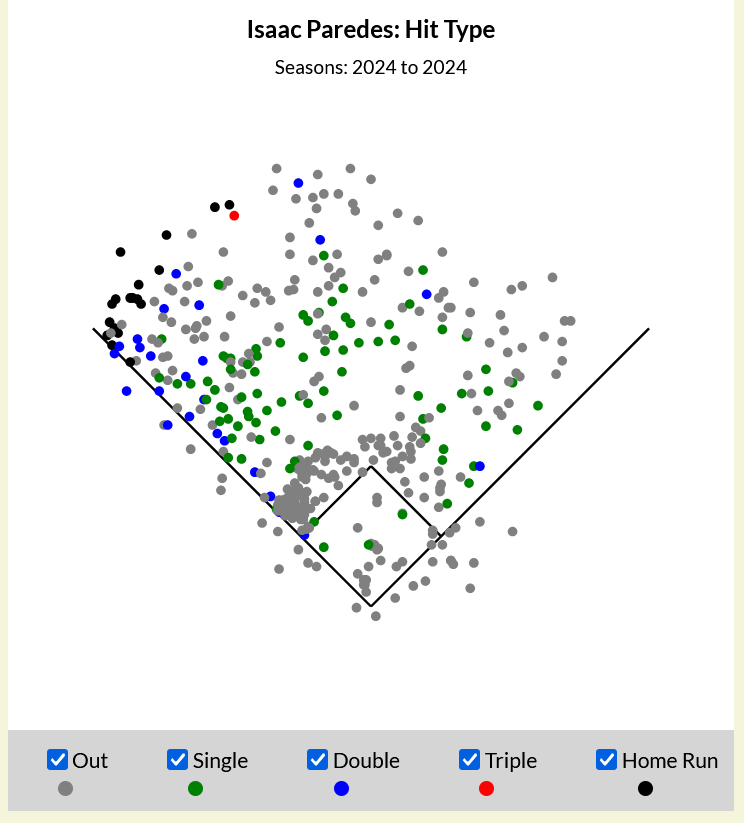
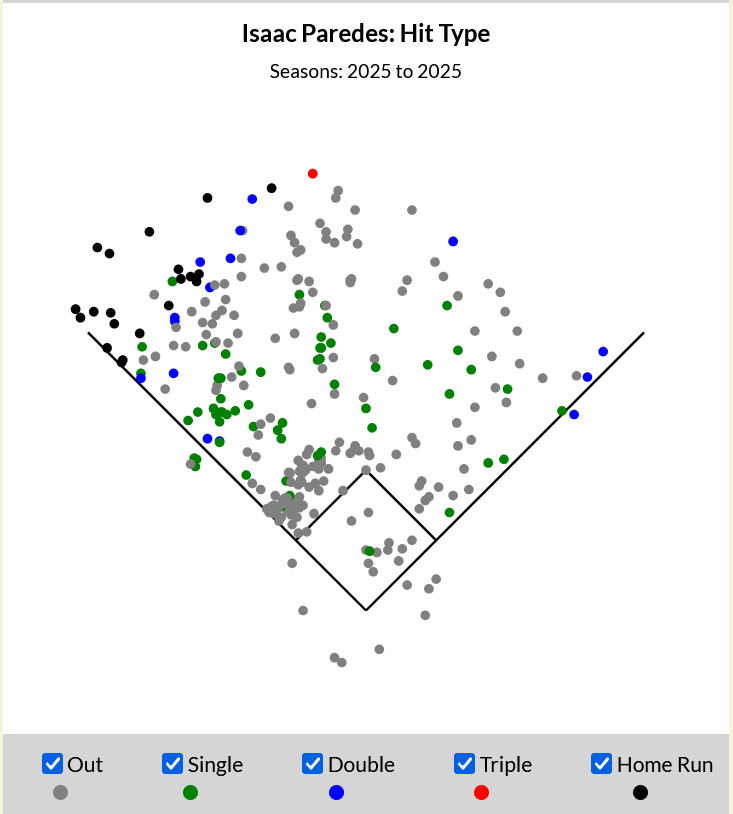
Wrigley’s 355-foot left field killed him in 2024. Minute Maid’s 315-foot Crawford Boxes let him thrive. Any team acquiring Paredes needs to understand: this isn’t a plug-and-play bat. It’s a bat that needs the right ballpark to unlock.
The 26-year-old third baseman slashed .254/.352/.458 with 20 home runs in an injury-shortened 2025, and he’s under team control through 2027 at a reasonable clip (projected ~$9M in arbitration). An All-Star, cost-controlled, AND young infielder? That’s what contenders crave.
Astros fans will rightfully say that they are also (quasi) contenders. And they’re right. The dynasty window isn’t closed, but it’s certainly not as wide open as it was when the Astros were winning pennants like they were participation trophies. The question isn’t whether the Astros should trade Paredes. It’s who offers the best return that stocks the farm while keeping the 2026 squad competitive.
What the Astros should prioritize:
1) A top-100 prospect (~50FV)/ a 45-50 FV piece, or enough lower-tier bites at the apple to aggregate similar value (40+ FV or below)
2) An MLB caliber outfielder (Jesus Sanchez in the outfield isn’t cutting it in the big 2026)
Who they’re targeting team-wise:
1) Teams with a pull-friendly park (letting Paredes smash, no Cubs redux)
2) Desperate teams
The Boston Trade Party
After surprisingly losing Bregman to the Cubs, they’re swimming in outfielders and pitchers but are bereft of infielder help. That matters in the AL East arms race with the Orioles signing the Polar Bear, the Jays getting Okamoto and Cease, and the Yankees re-signing Bellinger and trading for Ryan Weathers from the Marlins. Fenway doesn’t hurt either (310’ to left, 302’ to right). Paredes’s pull-heavy swing and the Green Monster? A match made in heaven.
The Headliner: Wilyer Abreu
Abreu won the Gold Glove in right field last year. That’s not a typo. A 26-year-old with elite defence, 22 home runs, and a .786 OPS who’s controlled through 2030? That’s the centrepiece, not Tolle. The catch (because there’s always one): his platoon splits are hideous. We’re talking .589 OPS against lefties. That’s replacement-level (maybe a bit better). Against righties, though, he’s a legitimate above-average bat with plus-plus defence. Houston’s outfield situation is dire enough that even a platoon piece with this much upside fixes it tomorrow.
The Prospect: Payton Tolle
Tolle is a 6’6” monster out of TCU who led all Red Sox minor leaguers in strikeouts last year (133 K in 91.2 IP across three levels). His fastball sits 95-96 and touches 99 with 96th percentile extension (same as Aroldis Chapman, for reference). The secondaries need work, and his MLB debut was ugly (6.06 ERA), but that’s a ceiling you dream on. Houston’s pitching development factory (Ronel Blanco, Gerrit Cole, Framber Valdez) could turn him into a No.2 Starter.
The Comp: Kris Bryant Trade (2021)
If Boston prefers Tolle + Abreu, it mirrors the Bryant deal that sent Alexander Canario (Giants’ No. 9 prospect) and Caleb Kilian to the Cubs for a two-month rental. Paredes has two years of control versus Bryant’s two months, so this package might actually be light. The Astros could push for more.
The Yoshida Wrinkle
Boston might want to dump Masataka Yoshida’s contract (~$37M remaining through 2027). He’s a DH-only bat at this point, injury-limited to a 93 OPS+ in 2025, but the man simply doesn’t strike out (11.7% K rate). If Houston eats salary, they unlock premium pieces. Yoshida + Tolle + Ward = Paredes suddenly puts a Top 100 calibre arm and an All-Star outfielder on the table. Taking the bad contract nets another promising prospect.
Puncher’s Chance for the Phillies?
The Phillies are a certified contender. They’re also getting old (sports-wise, even I don’t think a lineup on the wrong side of 30 is old in real life). Their lineup couldn’t score against the Dodgers in the playoffs, and adding a 120+ wRC+ bat like Paredes would go a long way in addressing that. Alec Bohm, their incumbent 3B, also happens to be entering his final year of control. The park dimensions (329’ to left, 330’ to right) aren’t as tailor-made for Paredes’s pull swing as Fenway, but Citizens Bank has always played as hitter-friendly. That’s a desperate team who needs a punchy 3B solution. The Astros can fix that.
The Piece: Brandon Marsh
Marsh hit .280/.342/.443 in 2025 with a monster September (.388). He’s a Gold Glove finalist, left-handed, and gives Houston a good 3rd outfielder. The platoon splits are severe (like everyone on this list, apparently), but he’s the real deal defensively.
The Prospects: Moises Chace + Aroon Escobar
Chace was a premium arm before Tommy John surgery in May 2025. His fastball sat 94-95 and peaked at 98 with elite ride and a plus sweeper. He struck out 35 in 19.2 innings across High-A and Double-A in 2024, walking only 10. But something was off all spring. His velocity cratered to 90.8 mph, and nobody could figure out why until he left a start in the second inning pointing at his elbow. He’s out until mid-2026 at the earliest, which tanks his value, but the upside remains. The Phillies added him to their 40-man this winter for a reason.
Escobar is a quieter but arguably safer piece. The 20-year-old Venezuelan broke out in 2025, slashing .270/.361/.413 with 15 home runs and 24 steals across three levels. His 18.2% strikeout rate is excellent for his age, and his 90th percentile exit velocity (104.7 mph) suggests the power is real. The swing is compact and quick from the right side. 92% zone-contact rate, near the top of the league. The issue? He can’t pull the ball with authority yet. (Baseball America’s words, not mine). he needs to learn to turn on pitches to unlock his power. Sliders and changeups when he’s sitting fastball? He gets beat. Defensively, his body is soft, his footwork gets lazy, and scouts question whether he sticks at second base. But the bat-to-ball skill is real. He’s a 45FV guy with a ceiling as an offensive-minded second baseman and a floor as a utility bat.
The Comp: Ryan McMahon Trade (2025)
When the Yankees acquired McMahon from Colorado at the deadline (two-plus years of control, ~$36M remaining), they sent back Griffin Herring (Yankees’ No. 17 prospect) and Josh Grosz (11th-round pick). That was widely called a salary dump with a light return. Paredes is a better hitter than McMahon was in 2025 (.254/.352/.458 vs .217/.314/.403), so the Phillies package should be richer. Marsh + Chace + Escobar = Paredes works, but given Chace’s TJ situation, Houston could reasonably demand another piece.
Viva Las Vegas (A’s Trade?)
The A’s might actually be good in 2026 (I know, I know). Their temporary Sacramento park (330’ to left, 325’ to right) plays great for pull hitters, and Paredes would get to face the Astros multiple times a year in hitter-friendly AL West parks. When they eventually move to Vegas, the dimensions get deeper (340’ down the lines, 415’ to centre), but Paredes would be a free agent by then anyway. For the two years Houston controls him, Sacramento is the perfect home.
The Bat: Devin Taylor
Taylor surpassed Kyle Schwarber’s home run prowess at Indiana (they share an alma mater, which is a fun bit of trivia and absolutely nothing else). He slashed .300/.400/.600 basically every year in college, then carried it over to pro ball with a 135 wRC+ in A-ball. The swing is simple: bat flat above the back shoulder, small leg kick, minimal hand drift, above-average bat speed. Baseball America calls it “a simple and repeatable operation without a lot of moving parts.” He posted a sub-20% chase rate in 2025 and uses all fields, not just pulling everything. The concern? A high strikeout rate that needs refinement before he sees upper-level pitching. He’s a 45FV guy with a ceiling worth dreaming on and a floor where he whiffs at every breaking ball.
The Arm: Mason Barnett
Barnett isn’t sexy. He’s a 25-year-old right-hander projecting as a No. 4/5 starter, which sounds like the baseball equivalent of “he has a great personality.” But he’s already at Triple-A, and his release points grade above-average across all his pitches (deception matters). The concern? His K-BB% dropped from 19.8% in Double-A to 10.8% in Triple-A. That’s the kind of regression that suggests the stuff doesn’t play up against better hitters. Houston’s pitching lab could squeeze more out of him, but the margin for error is thinner than the other arms on this list.
The Lottery Ticket: Wei-En Lin
Lin is 20 years old with a 12.10 K/9, a 2.28 BB/9, and an elite 27.1% K-BB% across a four-pitch mix (fastball, slider, curve, change). Ridonkulous. He’s a 40FV arm right now because the stuff is fringy, but if the velocity ticks up even slightly, you’re looking at a mid-rotation starter. If it doesn’t, he’s a command-first reliever. Classic lottery ticket, but the floor plays.
The MLB Option: Carlos Cortes
Cortes finally reached the majors at 28 after eight years in the minors and immediately raked (.309/.323/.543, 132 wRC+ in 42 games). Left-handed bat, solid defence, under control. If Oakland prefers to keep their lottery tickets, Barnett + Lin + Cortes = Paredes gives Houston an MLB-ready outfielder plus two pitching prospects.
The Comp: Eugenio Suárez Trade (2025)
When the Mariners reacquired Suárez from Arizona at the deadline (rental, but 36 home runs and MLB’s RBI leader), they sent Tyler Locklear (Mariners’ No. 9 prospect), Hunter Cranton (No. 16), and Juan Burgos (No. 17). That was for a rental putting up monster numbers. Paredes has two years of control, so Oakland’s packages should be heavier. Taylor + Barnett + Lin = Paredes is appropriately aggressive.
The Bronx Bombers
The Yankees need a third baseman. It’s not complicated. They have Judge, occasionally-healthy Stanton, and occasionally-useful Bellinger, but the hot corner has been a problem. Yankee Stadium’s short porch (318’ to left, 314’ to right) would turn Paredes into a 30-home-run threat.
That Guy: Dax Kilby
Kilby is a 2025 first-round pick (39th overall) who spurned a Clemson commitment for $2.8M (big money). In his pro debut with Low-A Tampa, he looked like, well a pro: .348/.434/.435 with a 13.2% walk rate and an 11.3% strikeout rate in 53 plate appearances. That’s a 150 wRC+ as an 18-year-old facing pitchers four years older than him. The bat-to-ball skills are clear (he went 16-for-37 after an 0-for-9 start), his athleticism is 80 grade, and scouts clocked a 40-inch vertical at fall instructs. That’s not a baseball stat, but it tells you something (that he can jump really high, but also he’s a capital A Athlete). The concerns? A 55% groundball rate suggests he’s not getting lift on the ball yet, and his below-average arm will likely push him off shortstop to second base or the outfield. But the hit tool projection is real. If he keeps this up, he’ll be a consensus Top 100 prospect by midseason.
The Other Guy: Jace Avina
Avina’s 2025 was a breakout. After struggling in 2024, he posted a .419 OBP and 155 wRC+ in High-A with improved contact, walk, and flyball rates before earning a promotion to Double-A in July. He’s 22 with plus raw power from the right side (the kind that made him Arizona Complex League MVP back in 2022 when he led the circuit with 10 homers in 36 games). The concern is the same one that’s followed him his entire career: a 31%+ strikeout rate that spikes whenever he faces quality pitching. He’s a go big or go home type of player. Scouts grade his power double-plus, but he expands the zone hunting home runs and gets exploited against secondary stuff. Houston’s buying the tools and hoping the production follows.
The Comp: Brandon Lowe Trade (2025)
When the Pirates acquired Lowe (two-time All-Star, one year of control, $11.5M salary) from Tampa in the three-team deal, the Rays received Jacob Melton (Astros’ No. 1 prospect at the time) and Anderson Brito (Astros’ No. 3). That’s two top-10 system prospects for one year of an All-Star infielder. Paredes has two years, so Kilby + Avina = Paredes is reasonable. Both are good prospects, but neither is untouchable.
The MLB Piece: Amed Rosario
Rosario is 30, which feels impossible given he was the Mets’ top prospect roughly a decade ago. He’s a super-utility guy now (2B/SS/3B/OF), acquired from the Nationals at the deadline and re-signed for a cheap $2.5M in December. The overall numbers are meh (.276, 6 HR), but the value is specific: he mashes lefties (.302/.328/.491 in 2025). That’s a useful bench bat for a Houston team that needs right-handed depth.
The Overrated Guy (The Spencer Jones Problem)
You (maybe) know him. I (definitely) know him. He’s 6’7”, 240 pounds, and he can hit the ball a mile. 35 home runs and 29 steals in 2025 between Double-A and Triple-A. But here’s the problem: he struck out 179 times doing it, good for a 35.3% strikeout rate. That’s not a typo. In 2024, he became the first Yankee minor leaguer ever to strike out 200 times in a season. His career 32.5% strikeout rate is higher than every hitter with 500+ MLB plate appearances in the 21st century except Joey Gallo. The June-July hot streak (.388/.457/.860 with 18 homers in 32 games) was real, but so was the August-September collapse (.210/.281/.375) when Triple-A pitchers stopped throwing him fastballs and started burying him with sliders. Jones + Rosario = Paredes would work on paper, but Houston might be getting a name rather than a player. Proceed with caution.
The Verdict
If I’m Dana Brown, I’m calling Boston first. The Abreu package is what the Astros need: an MLB-ready outfielder who solves a problem tomorrow, plus a Top 100 arm with top-notch ceiling. The Yoshida salary-dump variants unlock even more, but that requires Houston to eat ~$37M over two years. Whether ownership would stomach such an expense is a different conversation.
If Boston balks, Oakland’s Cortes package is the pivot. Cortes gives Houston an MLB-ready outfielder (left-handed, solid defence, 132 wRC+ in his debut), and you still get two pitching prospects with upside. It’s not as good as the Boston return, but it’s the cleanest path to “help now and help later.”
Philadelphia comes third. Marsh is the best defensive outfielder on this list and his September heater showed what he’s capable of. But Chace’s elbow and Escobar’s limited ceiling make this a riskier bet than the top two options. Houston could reasonably demand another piece given the TJ situation.
The Yankees have the individual talent (Kilby’s bat-to-ball, Avina’s raw power), but getting both in one package might require more negotiating leverage than Houston has. And the Spencer Jones question looms over everything. Is he a future All-Star or Joey Gallo with more steps? Odds are against him.
Now, if you’re purely maximizing prospect haul and don’t care about MLB-ready help, the calculus flips. Oakland’s prospect-only package (Taylor + Barnett + Lin) is the best bet. Taylor’s power ceiling is real, and Lin’s command at 20 years old is almost preternatural. The Yankees slot second in that scenario, with Philadelphia a distant third.
In a perfect world, Houston moves Christian Walker instead. He’s the actual roster problem (albatross contract, blocking Paredes at first), but his trade value is nonexistent right now. So you work with what you have. Paredes is the asset. The infield logjam is the problem. One trade solves both.
Contending and rebuilding aren’t mutually exclusive. Not if you do it right.