- AAV - Average Annual Value, or total contract value divided by years
- NPB - Nippon Professional Baseball (Japanese professional league)
- CBA - Collective Bargaining Agreement between MLB and the players’ union
- CBT - Competitive Balance Tax (luxury tax threshold)
- ALCS - American League Championship Series
- GB% - Ground Ball Percentage
- HR/FB - Home Run to Fly Ball ratio
- wRC+ - Weighted Runs Created Plus (100 is league average)
- fWAR - FanGraphs Wins Above Replacement
New year, new Astros. On the nose? Yes, but free agent Tatsuya Imai decided to lean into it by signing for 3 years, $54 million (up to $63 million with incentives). All of a sudden, a weak Astros’ rotation that was Hunter Brown and a box of scraps is now a rotation teams have to respect. However, for every Ohtani and Yamamoto (to pull recent examples) who had immediate success when coming from the NPB to the MLB, there’s also Masataka Yoshida and Kei Igawa who disappointed. Given how Imai signed for a smaller deal than expected, are teams expecting him to fall in the latter category or is there another reason for that?
The Short Deal and the Looming Lockout
3 years, $54 million (up to $63 million with incentives) is a far cry from the original projections of 6 years, $150 million. Young, talented pitching doesn’t come available often, so the gap is surprising at first glance.
Here’s the thing, if Imai hits his incentives ($1 million each for reaching 80, 90, and 100 innings), his AAV jumps to $21 million. That’s only $4 million off the $25 million AAV he was originally projected to get. Not a hometown discount. A bet on himself.
The opt-outs after every season make the structure even more player-friendly. The CBA expires after 2026, and another lockout is a real possibility. Imai can prove himself this year, opt out, and test free agency before the labor situation gets ugly. If he struggles, he’s still got two more years of guaranteed money. Heads he wins, tails he doesn’t lose.
From Houston’s perspective, this is a reasonable price for a prospective No. 2 starter. If Imai performs, they either negotiate an extension or watch him walk and collect the comp. pick. If he flames out, they’re not buried under a six-year albatross. Both sides built in flexibility. The deal also keeps Houston under the $244 million CBT threshold ($220 million + $18-21 million = $238-241 million), showing Dana Brown’s bargaining chops in the process.
Imai wanted to “compete for championships (not on the Dodgers).” He’s joining a team that’s made 7 out of the past 9 ALCS and made 4 World Series (winning 2). He set himself up well for the future. Boras didn’t get the megadeal he usually does. Lucky for Houston. A win is a win.
An Unconventional Pitch Mix
The walk rate improvement (11.4% to 7.0% over two years via mechanical changes) plus the batted ball profile suggests this isn’t a guy riding a hot streak. The underlying numbers support the surface results.
He keeps the ball on the ground at an above-average clip (48.3% GB%), and more importantly, he’s become elite at limiting damage. His 4.6% HR/FB rate and 16.5% hard-hit rate mean even his fly balls aren’t leaving the yard. Six homers in 163 innings. That’s Valdez-like run prevention through a slightly different path. (Valdez runs a 60% ground ball rate. Imai won’t match that, but nobody really does.)
The low release point helps explain why. His release height sits about 10 inches below MLB average, per pitching analyst Lance Brozdowski, creating a flat approach angle that’s hard to elevate or get under. NPB pitchers attack the top of the zone less frequently than MLB arms, but when Imai went up there, opponents hit .140 against fastballs in the upper half. There’s room for Houston’s staff to unlock more by getting him to elevate consistently (see Gerrit Cole for rapid improvement when joining Houston).
He has a 6-pitch mix (four-seamer, slider, changeup, curve, splitter, vulcan-change) that cooked both right- and left-handed batters equally.
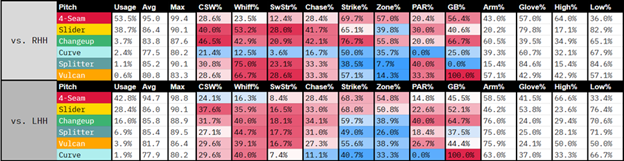
Against righties, he’s a four-seam and slider merchant, forcing ground balls with the four-seamer and getting batters to swing and miss with the slider. Lefties get the full mix, with a more even three-headed split between his four-seamer, slider, and changeup with his other secondaries getting play as well.
That slider is money. It breaks arm-side rather than glove-side, the opposite of nearly every slider in professional baseball. Trey Yesavage’s is really the only comparable one in the MLB (and the reason why Stuff+ models don’t like it, not many comps.). Imai’s version generated a 40% whiff rate against righties, 36% against lefties. MLB hitters won’t have a reference point for it (well, just the one). If it translates, the ceiling is higher than “solid No. 2.” If it doesn’t, the floor (ground balls, limited hard contact, improved command) still plays. That’s the bet Houston is making.
From Brown and Question Marks to Something Real
With the addition of Imai, the Astros’ opening day rotation has gone from Brown, Javier, McCullers Jr., Burrows, Weiss/Arrighetti/Alexander to Brown, Imai, Javier, Burrows, McCullers Jr. Ace, question marks and a recent trade (Burrows) to a passable rotation. If Imai hits his peak, the rotation goes from passable to strength. Not a bad upside play for $18-21 million.
Currently 20th in projected rotation fWAR. Add Imai’s 1.8 projection, they’re league average, third in the AL West. That’s the floor: a rotation that’s no longer a liability. The ceiling, if the backwards slider and top-of-zone stuff translate, is a top-ten unit with two legitimate aces.
The Triple-A depth (Pecko, Blubaugh, Ullola) means the fifth spot isn’t welded to McCullers and his injury history. Options instead of prayers.
Add in that the Astros have six batters in their lineup with wRC+ over 100 (and the other three in the 90’s), and that’s a potential contender. Perhaps even a Dodger beater? (Imai believes so)
Before signing Imai, the rotation was the Astros weakness. Now, if not the absolute strength, it’s right there. Three words best describe it. Astros, must see TV.